
Search Engine Submission: A Practical Guide to Getting Your Website Found
Search Engine Submission: A Practical Guide
Search engine submission is the process of notifying search engines that a website or page is available to be crawled and considered for inclusion in search results. It can help search engines discover new content, but it does not guarantee that a page will be indexed or appear in a particular position.
How search engine discovery works
Search engines use automated programmes, often called crawlers or bots, to find and revisit web pages. They discover pages by following links and consulting information such as XML sitemaps. After crawling a page, a search engine may decide whether to add it to its index. Indexed pages can then be considered for relevant search queries.
These are distinct stages:
- Discovery: The search engine learns that a page exists.
- Crawling: A crawler visits the page and accesses its content.
- Indexing: The search engine assesses the page and may store it in its index.
- Ranking: The search engine determines where the page may appear for a particular search.
Submitting a URL mainly helps with discovery. It does not bypass the other stages or guarantee rankings.
When should you submit a website?
Search engines may find a website naturally, especially if other established websites link to it. However, submission can be useful when launching a new site, publishing important pages, or making substantial updates. It can also help you identify technical problems that might prevent crawling or indexing.
Ways to submit your website
Verify your site with search engine tools
Google Search Console and Bing Webmaster Tools allow site owners to verify their websites and monitor how they perform in search. Once verified, these tools can provide information about indexing, crawling issues and search visibility. They also offer ways to submit sitemaps and, in some cases, request that individual URLs be recrawled.
Use the official tools provided by each search engine. Be cautious of third-party services that promise instant indexing or guaranteed rankings.
Create and submit an XML sitemap
An XML sitemap lists important URLs on your website and can include details such as when a page was last modified. It is particularly useful for large websites, sites with complex navigation, and new websites with few links from other sources.
Make sure the sitemap contains canonical, indexable pages that return a successful response. Remove URLs that are redirected, blocked from crawling, or marked as noindex. You can usually submit the sitemap through a search engine’s webmaster tools. Adding its location to your robots.txt file can also help crawlers find it.
Request indexing for individual URLs
If you have updated an important page, you may be able to use a URL inspection feature in a webmaster tool to check its status and request a fresh crawl. This is best used selectively for priority pages, rather than repeatedly submitting every URL on a site.
Make pages easy to discover through links
Internal links help crawlers and visitors move between related pages. Link to important content from relevant areas of your site, such as the navigation, category pages or related articles. External links from reputable websites can also help search engines discover your pages, though links should be earned naturally rather than acquired through manipulative schemes.
Check that your pages can be crawled and indexed
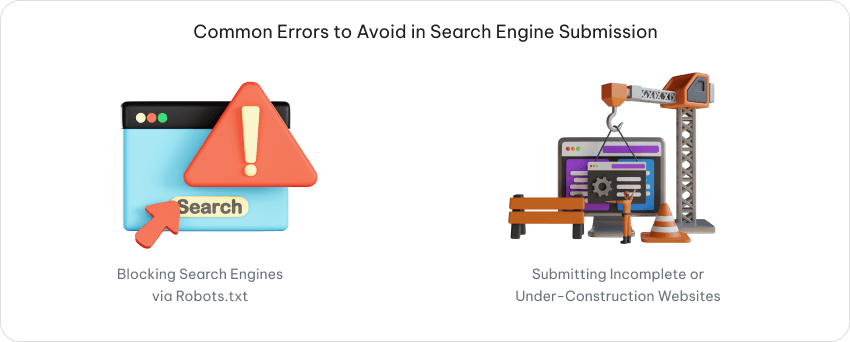
Before submitting pages, check that search engines can access them. Common issues include:
- A
robots.txtrule that blocks important pages or resources. - A
noindexdirective that tells search engines not to index a page. - Broken links, server errors or pages that require a login.
- Redirects that lead to the wrong destination or create long redirect chains.
- Duplicate pages without clear canonical signals.
- Content that is difficult to access or understand, including pages that rely heavily on inaccessible scripts.
Do not block a page in robots.txt if you need a search engine to read a page-level noindex instruction. If the page cannot be crawled, the crawler may not see that instruction.
Submission is not the same as SEO
Submitting a website is only one small part of search engine optimisation (SEO). It can help with discovery, but it cannot make thin, outdated or unhelpful content rank well on its own. Pages should answer users’ questions, have clear titles and headings, load reliably, work on mobile devices and provide a straightforward experience.
Search engines decide independently whether and when to crawl, index and rank content. Processing times vary, and some pages may not be indexed if they offer little unique value or have technical issues.
Common misconceptions
- “Submitting a URL guarantees a search listing.” It does not. Submission is a request or discovery signal, not a guarantee of indexing.
- “Every page must be submitted individually.” Usually not. A well-maintained sitemap and clear internal links are often more practical.
- “Repeated submissions improve rankings.” Repeatedly requesting indexing does not replace useful content or sound technical SEO.
- “Paid submission services can guarantee results.” No legitimate service can guarantee that a search engine will index a page or rank it highly.
A simple submission checklist
- Make sure your website is accessible and returns the correct status codes.
- Check that important pages are not blocked or marked as noindex by mistake.
- Create an accurate XML sitemap and keep it up to date.
- Verify your website in relevant search engine webmaster tools.
- Submit your sitemap and inspect priority URLs where appropriate.
- Add useful internal links to new and important pages.
- Monitor indexing reports and fix any issues identified.
Final thoughts
Search engine submission can help search engines find your website, particularly when it is new or has recently changed. The most effective approach is to combine official webmaster tools and a clean sitemap with accessible pages, helpful content and a logical internal link structure. Once those foundations are in place, monitor your site’s indexing status and make improvements where needed.
5 Practical Tips for Submitting Your Website to Search Engines
- Submit your sitemap through Google Search Console and Bing Webmaster Tools.
- Check that search engines can crawl your pages.
- Use URL inspection tools to request indexing for key pages.
- Keep page titles and descriptions clear and relevant.
- Avoid services promising guaranteed or instant indexing.
Submit your sitemap through Google Search Console and Bing Webmaster Tools.
Submitting your sitemap through Google Search Console and Bing Webmaster Tools helps Google and Bing discover the important pages on your website. First, make sure your XML sitemap is up to date and contains the correct, indexable URLs. Then verify your site in each tool and submit the sitemap using its sitemap feature. Submission does not guarantee that every page will be crawled or indexed, but the tools can report whether the sitemap was read successfully and highlight potential issues.
Check that search engines can crawl your pages.
Before submitting your pages, check that search engines can crawl them. Make sure important pages aren’t accidentally blocked by your robots.txt file, require a login, or return errors such as “404 Not Found”. Also check for a noindex instruction if you want a page to appear in search results. Fixing these issues helps search engines access and assess your content, although it doesn’t guarantee that a page will be indexed.
Use URL inspection tools to request indexing for key pages.
Use URL inspection tools in platforms such as Google Search Console or Bing Webmaster Tools to check whether important pages can be crawled and indexed. If a key page is new or has recently been updated, you may be able to request that the search engine recrawl it. Prioritise pages that matter most to your visitors, such as major service pages or important articles, and remember that a request does not guarantee indexing or higher rankings.
Keep page titles and descriptions clear and relevant.
Keep page titles and descriptions clear, accurate and relevant to each page’s content. A concise, descriptive title helps search engines and visitors understand what the page is about, while a useful meta description can encourage people to click when it appears in search results. Avoid vague wording, keyword stuffing and descriptions that promise more than the page delivers. Titles and descriptions do not guarantee indexing or higher rankings, but they help present your pages clearly to potential visitors.
Avoid services promising guaranteed or instant indexing.
Avoid services that promise guaranteed or instant indexing. Search engines decide for themselves whether and when to crawl and index a page, so no third-party service can reliably guarantee inclusion or a specific timeframe. Use official webmaster tools to submit your sitemap or request that important pages be crawled, then focus on making your content accessible, useful and technically sound.